what the proper temperature to install timberline architectural shingle

Source
Spahn & Rose Lumber Co. offers more than much than merely lumber. With a wide variety of interior and outside building materials, Spahn & Rose has partnerships with industry-leading brands, such every bit GAF, one of the country'southward most pop shingle brands. With extensive cognition of GAF shingles, Spahn & Rose experts designed a guide to help contractors in Iowa, Illinois and Wisconsin install GAF Timberline® roofing shingles, part of the GAF Covering Arrangement.
Materials Available at a Spahn & Rose Near You lot
- GAF Timberline® roofing shingles
- GAF starter strips
- GAF Seal-A-Ridge® and Timbertex® ridge caps
- Chalk line
- Razor or utility pocketknife
- Galvanized roofing nails
- Hammer or blast gun
- Smart foursquare (optional)
- Pencil
- Tape measure
- Protective metal canvass
- Advisable personal protective equipment
Vanquish Roof Leaks With Properly Installed Starter Strips

Source
Starter strips are used as a guide to ensure all shingles are flush and level across the roof. They likewise provide a line of rut-activated adhesive to ensure the starting time line of shingles are properly fastened. For exposure less than 6", use either Pro-Start or WeatherBlocker starter strips.
- Measure the width of the starter strips, and then subtract the desired width for overhang, typically a ¼" to ¾".
- Mark the width of the starter strip, minus the overhang, onto the roof at both ends.
- Use a chalk line to marking a directly line on the roof between the two markings made at each end. This will ensure your start strips will exist straight and flush across the length of the roof.
- GAF starter strips come every bit a single piece that needs to be cut through the center to create two strips. Cut equally many strips as needed for the perimeter of your roof.
- Place the get-go starter strip at the lowest corner of your roof. Set it to include the desired overhang on both sides of the corner and flush with your chalk line. The adhesive tar strip should be closer to the baste edge of your roof than the top of your roof.
- The kickoff roofing nail should be placed 1.5" to 3" from the beginning side edge of the roof. Space the other 3 nails (yous should have 4 nails total for each strip) 10" to 12" apart, with the 4th blast leaving a space of 1" to ii" from the ending edge of the strip. This will proceed your starter strip more flush with your chalk line than working left to right.
- When installing Metric dimensioned shingles, you must trim 5" off the first WeatherBlocker starter strip or 3" off the first ProStart starter strip. This disquisitional step ensures that the starter strip butt joints and overlapping shingles barrel joints are off-set a minimum of 4". Depending on the length of the shingle being installed, a 10" to 12" department of starter strip may periodically need to be cut and installed to meet the required 4" showtime. Fasten the adjustment starter strip with two nails 1" to two" from each side end.
- Set the second starter strip in-line with the chalk line, directly next to the get-go strip. Smash as above. Continue to place and nail starter strips along the lowest line of the roof accordingly.
- At the far stop of the roof, cut the final starter strip (using a smart foursquare if needed) to let for the desired overhang. Nail into identify.
- Go on to set starter strips up the sides of the roof using the same overhang, chalk line, and nailing technique. Exercise not rely on the initial starter strips equally a guide for flushness. A chalk line will provide greater accuracy and quality of work.
Work Efficiently by Pre-Cutting GAF Shingles
GAF architectural shingles are designed to be laid in an offset pattern. This is both more aesthetically pleasing and improves drainage. To get the best expect, and for ease of installation, pre-cut the get-go shingle in each row from the bottom to the top of the roof.
- Measure shingles at recommended intervals (typically 6"). Mark each sheet to be cut at 6", 11" or 17" from the rake edge. GAF deck protection, part of the GAF roofing system, comes in a grid design that makes it like shooting fish in a barrel to mark these intervals.
- The lowest row of shingles will brainstorm with a full sail. Cut the remaining rows at the marked intervals. If the roof is tall enough, you may demand to start again with a full sheet midway, and so continue with pre-cut shingles.

Source
Best Fashion to Install GAF Shingles
- Begin by installing your pre-cut shingles to ensure your pattern is offset beyond the whole roof. Start by placing your beginning total canvass of shingles. This should completely overlay the starter strip at the lowest corner, including the overhang of the drip edge.
- Nails on GAF shingles become through the black marker strip. Nail the offset total sheet in the aforementioned way equally the starter strip, with one on each side, followed by a nail in the middle, and then at desired intervals or as required by local building codes.
- One time the first full sheet is in place, install the first pre-cut sheet directly above it. GAF shingles are designed with a white chalk guideline, which is used as a guide for the next row of shingles. The exposed area of the shingles below should be five ⅝". This ensures appropriate coverage, adhesion and water-tightness. Make certain the bottom of the pre-cut shingle is flush with the white chalk line. Nail into place.
- Go on with the rest of your offset ready of pre-cutting shingles. If the roof is large plenty that you reach a second full sheet of shingles, practice non nail this in place still.
- Once the first ready of pre-cut shingles is in place, y'all can proceed to blast total sheets of shingles, affluent with the one earlier information technology and also with the white chalk guideline, through the black tarline, across the roof. If your roof is a hip roof, cut the ends of the rows at the angle of the hip, leaving a small-scale gap on either side of the hip, so follow the instructions below for installing ridge caps.
- One time a full set of offset full-sheet shingles is installed, you lot can proceed with your next set of pre-cut shingles and echo Step 5 as needed until the roof is completely shingled.
- As you lot reach the acme of the roof, cutting the last row of shingles so that they are nigh flush with the peak and the final row on the other side. A small gap is commanded. A large gap will cause the ridge cap to bow.
- Once all shingles are in place, cut the far rake edge, including overhang. A chalk line will give the straightest line and cleanest cutting.
8 Smart Steps for Installing Shingles in Airtight-Cut Valleys
Valleys are where a roof meets a gable that is built perpendicular to the roof. Shingles must be installed correctly in valleys to ensure proper water runoff.
- Install shingles as described in the section to a higher place, just without cutting, since there is no baste edge, peak or hip.
- Ensure that shingles overlap the valley centerline by at least 12". Cut shingles that significantly exceed this length.
- Do not nail shingles inside half-dozen" of the valley centerline.
- Install shingles running from the gable edge or perpendicular roof to the valley, all the same ensuring the 12"-overlap and making sure there are no nails within half-dozen" of the centerline.
- Mark a chalk line downward the valley centerline.
- Using a protective metal canvass to ensure you don't cut also deep, cut the top layer of shingles along the valley centerline.
- To ensure proper drainage, cut the acme corner of each top shingle at a 45-degree angle from the height of the shingle to merely in a higher place the white chalk guideline.
- Apply a roofing cement between superlative and bottom shingle layers. Refer to manufacturer's instructions for the advisable curing time for roofing cement.
How to Ensure Ridge Caps Stay Watertight
Source
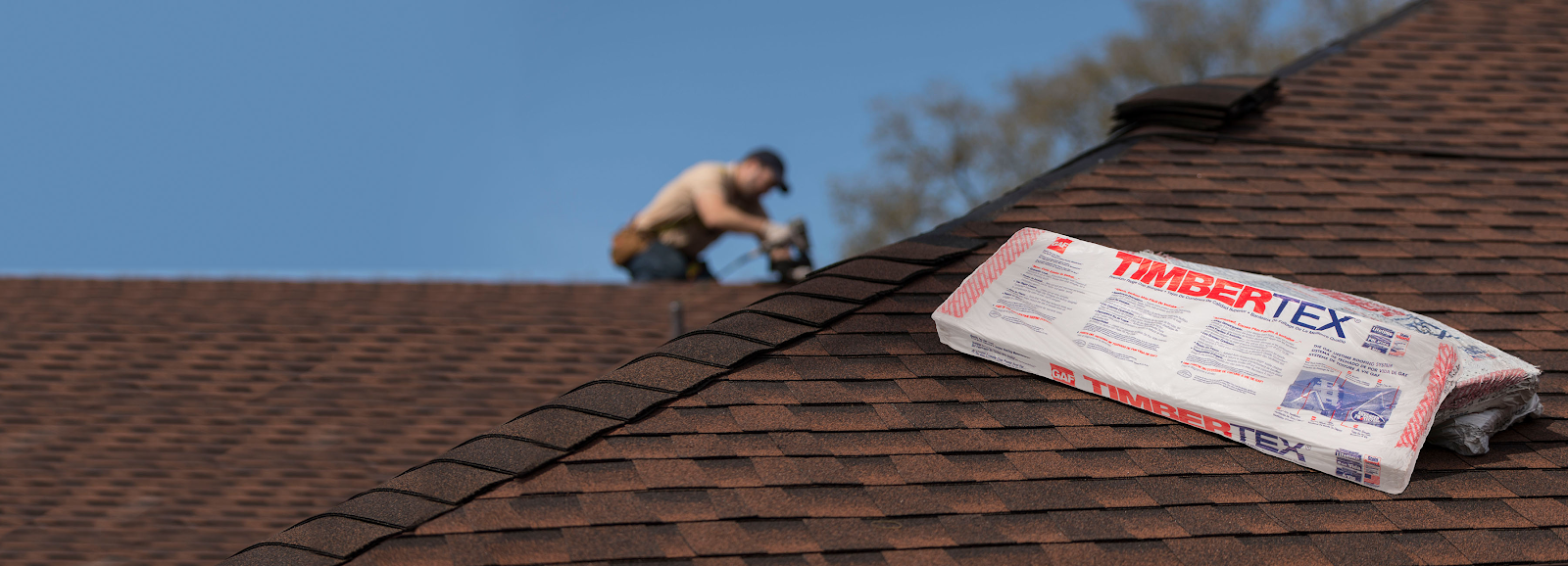
The ridge cap runs along the summit or hips of the roof, with tab shingles installed perpendicular to the architectural shingles. The ridge cap is there both for artful purposes—information technology hides the seams of the GAF shingles—and to ensure h2o-tightness.
- Using GAF Seal-A-Ridge or TimberTex ridge caps in the same color as your architectural shingles, separate the ridge caps at the perforated edges.
- Beginning at the everyman hip intersection and piece of work your mode up.
- Cut your starter course and align and then the adhesive is just inside the corner of the baste border.
- Fasten the shingle with two nails. Be sure to use only zinc-coated steel or aluminum, 10-12 gauge barbed, plain-featured or smooth shank roofing nails with heads 3/viii″ to 7/16" in diameter nails. The nails should be long enough to penetrate at least 3/4″ into wood decks.
- Trim the starter course affluent with the drip edge.
- The adjacent shingle should overlap the starter shingle completely, ensuring it extends past the drip edge on the eaves.
- Nail in place and trim affluent with the drip edge.
- Align the next shingle using the alignment notches in the headlap surface area as a guide, merely do non nail it downwardly nevertheless.
- Strike a chalk line upwards the hip, forth the edge of the two shingles and parallel to the hip center line.
- Nail down the second shingle.
- Go along to work your way upwardly the hip, keeping shingles aligned to the chalk line. Be sure to install shingles beyond the roof and on top of attic ventilation.
- When you attain the terminate, install a full shingle and fasten with two nails and then trim the shingle along the drip edge of the roof.
- To stop, apply 2 chaplet of roofing cement over the exposed nails.
Retrieve to give all GAF shingles enough time for tar lines to heat and cure. Refer to manufacturer'southward specifications regarding temperature and time.
Find out how Spahn & Rose can aid you complete your project on fourth dimension and within budget. Visit a nearby location or call for quick delivery of high-quality edifice materials.
Source: https://spahnandrose.com/blog/installation-guide-for-gaf-shingles/
0 Response to "what the proper temperature to install timberline architectural shingle"
Post a Comment