And Ahh Ahhh Ahhh Ahhh and You Already Know Song
| E | |
|---|---|
| Due east east | |
| (Run across below) | |
 | |
| Usage | |
| Writing organization | Latin script |
| Type | Alphabetic |
| Language of origin | Latin linguistic communication |
| Phonetic usage |
|
| Unicode codepoint | U+0045, U+0065 |
| Alphabetical position | 5 |
| History | |
| Evolution |
|
| Fourth dimension period | c. 700 BC to nowadays |
| Descendants |
|
| Sisters |
|
| Variations | (See below) |
| Other | |
| Other messages commonly used with | ee |


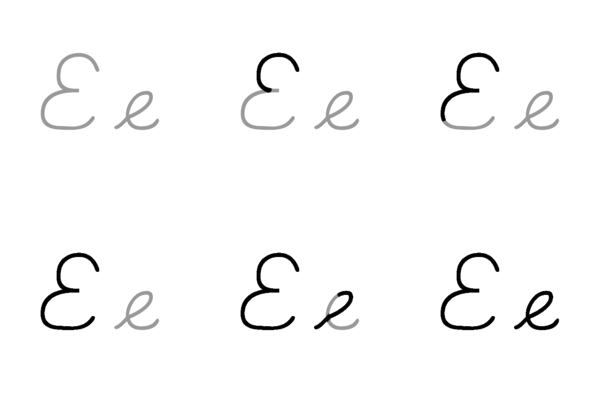
Due east, or eastward, is the fifth alphabetic character and the 2nd vowel alphabetic character in the modern English alphabet and the ISO basic Latin alphabet. Its name in English is e (pronounced ); plural ees,[1] Es or E'southward.[2] It is the about ordinarily used alphabetic character in many languages, including Czech, Danish, Dutch, English, French, High german, Hungarian, Latin, Latvian, Norwegian, Castilian, and Swedish. [3] [4] [5] [6] [7]
History
| Egyptian hieroglyph qʼ | Proto-Sinaitic | Proto-Canaanite hillul | Phoenician He | Etruscan E | Greek Epsilon | Latin/ Cyrillic East |
|---|---|---|---|---|---|---|
| |  |  |  |  |  |  |
The Latin letter 'E' differs little from its source, the Greek letter epsilon, 'Ε'. This in turn comes from the Semitic letter hê, which has been suggested to have started equally a praying or calling homo figure (hillul 'jubilation'), and was most likely based on a similar Egyptian hieroglyph that indicated a dissimilar pronunciation. In Semitic, the letter represented /h/ (and /eastward/ in foreign words); in Greek, hê became the letter epsilon, used to represent /e/. The various forms of the Sometime Italic script and the Latin alphabet followed this usage.
Use in writing systems

Pronunciation of the proper noun of the letter ⟨e⟩ in European languages
English
Although Middle English spelling used ⟨e⟩ to correspond long and short /east/, the Swell Vowel Shift changed long /eː/ (as in 'me' or 'bee') to /iː/ while short /ɛ/ (as in 'met' or 'bed') remained a mid vowel. In other cases, the letter is silent, by and large at the finish of words like queue.
Other languages
In the orthography of many languages it represents either [east], [e̞], [ɛ], or some variation (such every bit a nasalized version) of these sounds, frequently with diacritics (equally: ⟨e ê é è ë ē ĕ ě ẽ ė ẹ ę ẻ⟩) to indicate contrasts. Less commonly, as in French, German, or Saanich, ⟨due east⟩ represents a mid-central vowel /ə/. Digraphs with ⟨e⟩ are mutual to indicate either diphthongs or monophthongs, such as ⟨ea⟩ or ⟨ee⟩ for /iː/ or /eɪ/ in English, ⟨ei⟩ for /aɪ/ in German, and ⟨european union⟩ for /ø/ in French or /ɔɪ/ in High german.
Other systems
The International Phonetic Alphabet uses ⟨eastward⟩ for the shut-mid front end unrounded vowel or the mid front unrounded vowel.
Nearly common letter of the alphabet
'Eastward' is the nigh common (or highest-frequency) letter of the alphabet in the English language language alphabet (starting off the typographer's phrase ETAOIN SHRDLU) and several other European languages, which has implications in both cryptography and data compression. In the story "The Gold-Bug" by Edgar Allan Poe, a graphic symbol figures out a random graphic symbol code by remembering that the almost used letter in English is E. This makes information technology a hard and popular letter to use when writing lipograms. Ernest Vincent Wright's Gadsby (1939) is considered a "dreadful" novel, and supposedly "at least part of Wright's narrative bug were caused by language limitations imposed by the lack of E."[eight] Both Georges Perec's novel A Void (La Disparition) (1969) and its English translation past Gilbert Adair omit 'eastward' and are considered better works.[ix]
- E with diacritics: Ĕ ĕ Ḝ ḝ Ȇ ȇ Ê ê Ê̄ ê̄ Ê̌ ê̌ Ề ề Ế ế Ể ể Ễ ễ Ệ ệ Ẻ ẻ Ḙ ḙ Ě ě Ɇ ɇ Ė ė Ė́ ė́ Ė̃ ė̃ Ẹ ẹ Ë ë È è È̩ è̩ Ȅ ȅ É é É̩ Ē ē Ḕ ḕ Ḗ ḗ Ẽ ẽ Ḛ ḛ Ę ę Ę́ ę́ Ę̃ ę̃ Ȩ ȩ E̩ e̩ ᶒ[10]
- ⱸ : Due east with notch is used in the Swedish Dialect Alphabet[eleven]
- Æ æ : Latin AE ligature
- Œ œ : Latin OE ligature
- The umlaut diacritic ¨ used above a vowel letter in German and other languages to signal a fronted or front vowel (this sign originated every bit a superscript e)
- Phonetic alphabet symbols related to Eastward (the International Phonetic Alphabet only uses lowercase, just uppercase forms are used in another writing systems):
- Ɛ ɛ : Latin alphabetic character epsilon / open e, which represents an open up-mid front unrounded vowel in the IPA
- ᶓ : Epsilon / open e with retroflex hook[x]
- Ɜ ɜ : Latin letter reversed epsilon / open e, which represents an open-mid central unrounded vowel in the IPA
- ɝ : Latin small letter reversed epsilon / open e with hook, which represents a rhotacized open-mid cardinal vowel in the IPA
- ᶔ : Reversed epsilon / open e with retroflex claw[10]
- ᶟ : Modifier alphabetic character small reversed epsilon / open e[10]
- ɞ : Latin small letter airtight reversed open e, which represents an open-mid primal rounded vowel in IPA (shown as ʚ on the 1993 IPA chart)
- Ə ə : Latin letter schwa, which represents a mid key vowel in the IPA
- Ǝ ǝ : Latin letter of the alphabet turned e, which is used in the writing systems of some African languages
- ɘ : Latin letter reversed eastward, which represents a shut-mid central unrounded vowel in the IPA
- The Uralic Phonetic Alphabet uses various forms of e and epsilon / open due east:[12]
- U+1D07 ᴇ LATIN LETTER Small-scale Capital letter E
- U+1D08 ᴈ LATIN Pocket-sized Letter of the alphabet TURNED OPEN East
- U+1D31 ᴱ MODIFIER LETTER CAPITAL Eastward
- U+1D32 ᴲ MODIFIER LETTER Capital letter REVERSED E
- U+1D49 ᵉ MODIFIER LETTER Small-scale E
- U+1D4B ᵋ MODIFIER LETTER Minor OPEN E
- U+1D4C ᵌ MODIFIER LETTER Small TURNED Open up E
- U+2C7B ⱻ LATIN LETTER SMALL Capital letter TURNED E [13]
- east : Subscript minor eastward is used in Indo-European studies[14]
- Teuthonista phonetic transcription system symbols related to E:[xv]
- U+AB32 ꬲ LATIN SMALL LETTER BLACKLETTER E
- U+AB33 ꬳ LATIN SMALL LETTER BARRED E
- U+AB34 ꬴ LATIN SMALL LETTER E WITH FLOURISH
Ancestors and siblings in other alphabets
- 𐤄 : Semitic letter of the alphabet He (alphabetic character), from which the post-obit symbols originally derive
- Ε ε : Greek letter Epsilon, from which the following symbols originally derive
- Е е : Cyrillic letter Ye
- Є є : Ukrainian Ye
- Э э : Cyrillic alphabetic character E
- Ⲉ ⲉ : Coptic letter Ei
- 𐌄 : Old Italic E, which is the ancestor of modern Latin E
- ᛖ : Runic letter Ehwaz, which is possibly a descendant of Old Italic E
- 𐌴 : Gothic letter of the alphabet eyz
- Ε ε : Greek letter Epsilon, from which the following symbols originally derive
Derived signs, symbols and abbreviations
- € : Euro sign.
- ℮ : Estimated sign (used on prepackaged goods for sale within the European Union).
- due east : the symbol for the simple charge (the electrical charge carried past a single proton)
- ∃ : existential quantifier in predicate logic. It is read "there exists ... such that".
- ∈ : the symbol for ready membership in set theory.
- 𝑒 : the base of the natural logarithm.
Code points
| Preview | E | e | ||
|---|---|---|---|---|
| Unicode name | LATIN Capital Letter of the alphabet Eastward | LATIN SMALL LETTER Due east | ||
| Encodings | decimal | hex | dec | hex |
| Unicode | 69 | U+0045 | 101 | U+0065 |
| UTF-8 | 69 | 45 | 101 | 65 |
| Numeric character reference | E | E | e | e |
| EBCDIC family | 197 | C5 | 133 | 85 |
| ASCII 1 | 69 | 45 | 101 | 65 |
- one Besides for encodings based on ASCII, including the DOS, Windows, ISO-8859 and Macintosh families of encodings.
Other representations
In British Sign Language (BSL), the letter 'e' is signed past extending the alphabetize finger of the right hand touching the tip of index on the left hand, with all fingers of left hand open.
Utilise as a number
In the hexadecimal (base 16) numbering organization, E is a number that corresponds to the number 14 in decimal (base 10) counting.
References
- ^ "E" a letter Merriam-Webster'south Third New International Lexicon of the English Unabridged (1993). Ees is the plural of the proper noun of the letter of the alphabet; the plural of the letter itself is rendered E's, Eastsouthward, e'south, or es.
- ^ "E". Oxford Dictionary of English (3rd ed.). Oxford University Press. 2010. ISBN9780199571123.
substantive (plural Es or Eastward'due south)
- ^ Kelk, Brian. "Letter frequencies". Archived from the original on 2008-05-09. Retrieved 2022-02-02 .
- ^ Lewand, Robert. "Relative Frequencies of Letters in General English Patently text". Cryptographical Mathematics. Central Higher. Archived from the original on 2008-07-08. Retrieved 2008-06-25 .
- ^ "Frequency of Occurrence of Letters in Spanish". Santa Cruz Public Libraries. Archived from the original on 2008-05-11. Retrieved 2008-06-25 .
- ^ "Frequency of Occurrence of Letters in French". Santa Cruz Public Libraries. Archived from the original on 2008-03-12. Retrieved 2008-06-25 .
- ^ "Frequency of Occurrence of Letters in German". Santa Cruz Public Libraries. Archived from the original on 2012-06-28. Retrieved 2008-06-25 .
- ^ Ross Eckler, Making the Alphabet Trip the light fantastic: Recreational Word Play. New York: St. Martin'southward Press (1996): 3
- ^ Eckler (1996): iii. Perec'southward novel "was and then well written that at least some reviewers never realized the existence of a letter of the alphabet constraint."
- ^ a b c d Constable, Peter (2004-04-nineteen). "L2/04-132 Proposal to add boosted phonetic characters to the UCS" (PDF). Archived (PDF) from the original on 2017-10-11. Retrieved 2018-03-24 .
- ^ Lemonen, Therese; Ruppel, Klaas; Kolehmainen, Erkki I.; Sandström, Caroline (2006-01-26). "L2/06-036: Proposal to encode characters for Ordbok över Finlands svenska folkmål in the UCS" (PDF). Archived (PDF) from the original on 2017-07-06. Retrieved 2018-03-24 .
- ^ Everson, Michael; et al. (2002-03-20). "L2/02-141: Uralic Phonetic Alphabet characters for the UCS" (PDF). Archived (PDF) from the original on 2018-02-19. Retrieved 2018-03-24 .
- ^ Ruppel, Klaas; Rueter, Jack; Kolehmainen, Erkki I. (2006-04-07). "L2/06-215: Proposal for Encoding iii Additional Characters of the Uralic Phonetic Alphabet" (PDF). Archived (PDF) from the original on 2017-07-06. Retrieved 2018-03-24 .
- ^ Anderson, Deborah; Everson, Michael (2004-06-07). "L2/04-191: Proposal to encode 6 Indo-Europeanist phonetic characters in the UCS" (PDF). Archived (PDF) from the original on 2017-ten-11. Retrieved 2018-03-24 .
- ^ Everson, Michael; Dicklberger, Alois; Pentzlin, Karl; Wandl-Vogt, Eveline (2011-06-02). "L2/xi-202: Revised proposal to encode "Teuthonista" phonetic characters in the UCS" (PDF). Archived (PDF) from the original on 2017-x-11. Retrieved 2018-03-24 .
External links
Source: https://en.wikipedia.org/wiki/E
0 Response to "And Ahh Ahhh Ahhh Ahhh and You Already Know Song"
Post a Comment